Harz Mountains
The Best Werewolf Short Stories 1800-1849The Harz Mountains are the decisive wilderness of the narrative: a remote region where political exile, family catastrophe, hunting life, and supernatural threat become inseparable. Their forests conceal fugitives and dangerous beings alike, while their distance from courts, towns, and ordinary law allows buried histories to survive. In the story of Krantz’s family, the mountains are not merely a setting but the place where inherited violence acquires a legendary and possibly supernatural form.
Wilderness and Reputation
The mountains are introduced through the cultural reputation attached to them. Krantz tells Philip that the region is wild and surrounded by strange tales, while insisting that he has good reason to believe those tales true. Huntsmen know of particular places within the mountains that are believed to be inhabited by evil influences and habitually avoid them. This local knowledge gives the landscape a social geography: the forest is not uniformly mysterious, but contains marked spaces whose danger has been transmitted through custom and warning.
The mountains also belong to a wider European tradition of wolf superstition. Werewolves are described as sorcerers who assume the shape and nature of wolves through an enchanted girdle, and the French name for such a figure is loup-garou. The belief that a wolf which has tasted human flesh prefers it thereafter helps explain how animal behavior was transformed into stories of demonic appetite. In the Harz setting, the distinction between an actual predator and a supernatural agent remains deliberately unstable; fear grows precisely because the inhabitants cannot confidently decide which kind of danger they face.
Refuge for the Exiled
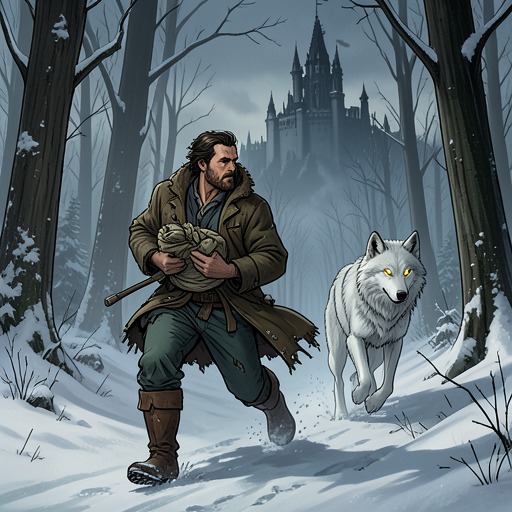
The Harz Mountains first become a refuge through the flight of Krantz’s father. He had been a wealthy and educated serf in Transylvania, raised by his noble master to the position of steward, yet still legally bound to remain a serf. After discovering his wife with the nobleman who had seduced her, he murdered both of them. Knowing that his status would prevent the provocation from being accepted as a defense, he took his three children, gathered what money he could, and fled by sleigh in the depth of winter. He continued without interruption until he had buried himself in the secluded intricacies of the mountains.
The family’s refuge is a rude but comfortable cottage on the edge of the vast northern German forests. It stands about two miles from any other habitation, with a few acres of uncertain farmland and a wide view of pines, descending forest, and the distant valley. Summer can make the prospect beautiful, but winter transforms it into a scene of extreme desolation. The father hunts for a living and often locks the children inside while wolves prowl outside, so the cottage becomes both shelter and confinement. The mountain environment therefore protects the fugitives from pursuit while isolating the children within the unresolved consequences of their father’s crime.
Gaspar de Marcanville in the Forest
A second history of exile attaches the Harz region to Gaspar de Marcanville. After De Saintefleur’s treachery caused Francis I to accept the false appearance of Gaspar’s guilt, Gaspar was degraded and banished. He withdrew with Rosalie de Marcanville and their daughter Adéle into the dark, almost boundless recesses of the Hanoverian Harz. The forest strips away the visible identity that had once belonged to a courtier: fatigue and sorrow make his former appearance unrecognizable, and survival replaces rank as the governing condition of life.
Gaspar preserves his accusation against De Saintefleur by writing a faithful account of the betrayal and obtaining a certificate from his confessor, Father Ægidius. He leaves the document with Rosalie, instructing her that it should reach Francis I if Gaspar dies during one of the hazardous excursions required to obtain their food. The mountains thus become an archive as well as a refuge. His written testimony is hidden within a landscape where political justice cannot immediately reach him, but where memory remains organized around the hope of eventual vindication.
Years of hunting sharpen Gaspar’s ability to survive. He is willing to surrender his own life to famine or the wolf, but the existence of Rosalie and Adéle binds him to continued effort; the wild buck cannot escape his spear, and even the bear is too weak to resist his attacks. Yet the forest’s privations gradually destroy the family. Gaspar’s grief and violent lamentations wear upon Rosalie, whose death about ten years after the exile leaves him a widower while Adéle is scarcely eighteen. The mountain’s violence is therefore gradual as well as spectacular: exile, labor, sorrow, and isolation erode the household before any single supernatural revelation completes its ruin.
The White Wolf and the Dangerous Clearing
The most important mountain episode begins when Krantz’s father encounters a large white wolf about thirty yards away. The animal retreats slowly, growling and snarling, but never fully escapes. It alternately leaves the hunter far behind, stops to defy him, and then speeds away again as he approaches. Because white wolves are rare, the father pursues it for hours up the mountain, allowing the desire to complete an exceptional hunt to override the warnings attached to the region.
The wolf leads him into an open space within the pine forest, one of the places specifically identified as dangerous. There the animal slackens its pace. When the father comes close, raises his gun, and prepares to fire, the wolf suddenly disappears. The snow may have dazzled his sight, but the disappearance cannot be explained by ordinary flight across the clear ground. The scene preserves the story’s characteristic economy of revelation: the threat is first made visible as an animal, then withdrawn at the instant of capture, leaving the hunter with an event that is undeniable in experience but resistant to rational reconstruction.
A horn then sounds in the wilderness. It is blown three times, signaling that a party is lost, and the father soon sees a mounted man with a woman seated behind him enter the clearing. The apparent rescue or encounter connects the white wolf’s lure with the family’s later history, though the mountains do not yield their meaning all at once. Their power lies in making ordinary motives—hunting, flight, shelter, and subsistence—open onto a supernatural possibility without completely cancelling their practical explanations.
From Legendary Forest to Fatal Landscape
The reputation of the Harz Mountains extends beyond Krantz’s immediate family. In the wider werewolf tradition, forests and graveyards become sites where famine, wolves, and human superstition reinforce one another. Ashford’s churchyard, for example, is said to have been a nocturnal haunt of the Wulfrics, although actual wolves had entered it during severe winters and disinterred the dead. The same interpretive pattern operates around the Harz: real animal danger supplies the material, while communal fear supplies the demonic explanation.
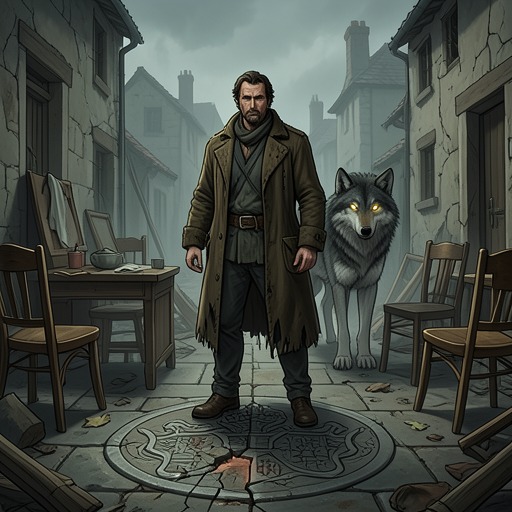
The mountains also echo through later reports of Wehr-Wolves in the Limousin. When Gaspar and Adéle settle near the forest of Saint-Yrieix, townspeople hear terrible howlings and the rush of a chase through deserted streets. Rather than confront the supposed monsters with weapons and brands, they fasten their windows more securely and abandon those already attacked. Children disappear from homes near the forest, and their partly devoured remains are found in the woods. The Harz has thus become a model for understanding other wildernesses: once a forest is associated with the wolf, distance, darkness, and unexplained death convert it into a self-reinforcing geography of dread.
Its final significance is sharpened by the fate of Krantz himself. Far from the Harz, after a journey involving Philip, he is carried away by an enormous tiger while retrieving clothing and supplies on the coast. The death recalls the fatal logic of the mountain tales: a person enters a dangerous environment under pressure, misjudges or cannot control the forces around him, and disappears with startling speed. The Harz Mountains remain the place where that logic was first formed in memory—through the father’s flight, the white wolf’s lure, and the family’s inherited catastrophe—and where the novel’s central uncertainty between human guilt, animal appetite, and supernatural judgment is given its most powerful landscape.